Systems | Development | Analytics | API | Testing

Test generation got free. Test governance didn't.

Over the past twelve months, something has shifted in how software teams think about quality. Claude Code, Cursor, and Playwright agents have made it genuinely easy to generate functional tests without deep automation expertise. The impact is showing up across two very different kinds of teams: Both paths lead to the same place: tests accumulate without governance, you get coverage without traceability, and there’s automation debt no one owns. But coverage numbers and quality are not the same thing.
8 Best Salesforce Data Cleansing Tools in 2026

Salesforce serves as the operational backbone for sales, marketing, and customer service teams worldwide. When that foundation contains duplicate records, incomplete fields, or outdated information, the consequences cascade throughout the entire organization. Sales teams waste hours chasing leads that already exist in another record. Marketing campaigns target contacts who left their companies months ago.

Role-Based Access Control (RBAC), Explained for Data Teams

Data teams face an impossible challenge: democratize data access across the organization while maintaining security controls and meeting regulatory requirements. Without a structured approach, engineering teams spend 15-25% of their time handling access requests instead of building data products. Role-Based Access Control (RBAC) transforms this operational chaos into a manageable system but only when implemented correctly.

Data Cleansing: The Complete Guide (Process, Techniques, Examples)

Data cleansing sits at the heart of every reliable data pipeline. Yet despite being essential to trusted analytics and decision-making, cleaning data remains one of the most time-consuming and undervalued steps in modern data workflows. With poor data quality creating significant operational challenges, getting data cleansing right has never been more critical.

Resource Planning in Power BI | Power ON Demo

See how to plan and allocate your team's resources directly inside Power BI. This demo walks through a resource management app built with Power ON from insightsoftware, where you can schedule people across projects, set rates, and track utilization against capacity without ever leaving Power BI. Power ON adds planning and write-back to Power BI, so your team can edit and save data right in a dashboard using a familiar, spreadsheet-style interface. In this walkthrough, we put those capabilities to work for resource and capacity planning.

SQL-Shaped Intent: The Engineering Behind AgentQL

Our CEO recently wrote reaffirming an architectural decision ThoughtSpot made when LLMs first emerged: we do not use LLMs to directly generate SQL. My team has spent the better part of a year building AgentQL: a capability that doubles down on our decision. So let me explain what we actually built, why it doesn't just honor that architectural decision but depends on it, and the engineering choices underneath.

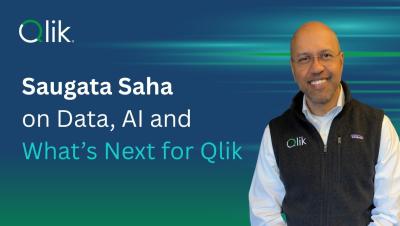
Saugata Saha on Data, AI, and What's Next for Qlik

Qlik CEO Saugata Saha sits down with Jessica DuBois, Senior Director of Global Tech Partners, for his first external conversation since joining the company. Saugata discusses what drew him to Qlik, the opportunity he sees at the intersection of data and AI, and why bringing increasingly capable AI together with trusted, governed data remains one of the most important challenges facing organizations today.

Ep 85 | Enterprise AI Success: What Separates Results from Expensive Experiments

Most enterprise AI use cases still aren't delivering measurable value. So what separates the projects that work from the ones that quietly disappear? For Mark Ritcey, the answer comes down to disciplined execution. AI programs need a clear business problem and an organization prepared for how the technology changes the way work gets done. In this episode of The AI Forecast, Paul Muller sits down with Mark Ritcey, Vice President of AI and Automation Delivery at Latentbridge and lecturer on AI and machine learning, to examine the decisions that shape enterprise AI success.

Owning the Agentic SDLC: How NodeSource Reclaimed Control of AI Development

TL;DR: When AI-assisted development moved from autocomplete to agentic workflows, the bottleneck for our engineering velocity stopped being the model and started being the vendor. Owning our own orchestration layer, running the same upstream agent stack across multiple developer surfaces, wrapping every change in a version-controlled spec, and treating the agent calls themselves as first-class telemetry is what made spec-driven development practical for us at NodeSource.