Systems | Development | Analytics | API | Testing

Operational Database Accessibility

This blog post is part of a series on Cloudera’s Operational Database (OpDB) in CDP. Each post goes into more details about new features and capabilities. Start from the beginning of the series with, Operational Database in CDP. Cloudera’s OpDB provides a rich set of capabilities to store and access data. In this blog post, we’ll look at the accessibility capabilities of OpDB and how you can make use of these capabilities to access your data.

Fresh Features: the upgraded user experience

We’re continuing our series on the slick new features and design that you can find in Yellowfin 9 - a game-changing analytics product packed with new capabilities to help you get to actionable insights faster. It was time for a change to the look and feel of the Yellowfin platform and we also knew that some of the workflows could be enhanced. So, the major release of Yellowfin 9 was our chance to give Yellowfin a new look and improve the user interface and workflows while we were at it.

Has Data, AI and Bots Brought Us Closer Than Ever To Achieving The Modern Day KITT Car?

As a kid, I loved the TV show “Knight Rider.” But, for me, the star of the show wasn’t David Hasselhoff, it was the intelligent automobile KITT. KITT – the Knight Industries Two Thousand – was smart, funny and sarcastic, which is always well received by us Brits.

Databox - How it works

Databox is a decision-making platform built to help you track performance, discover insights and understand what's going on with your business. It connects your cloud services, spreadsheets, databases and custom integrations to organize all of your business KPIs in one place. Databox will deliver your metrics via mobile, browser, big screen, Apple Watch®, and even Slack.

Changing the Approach to Debugging in Ruby with TracePoint

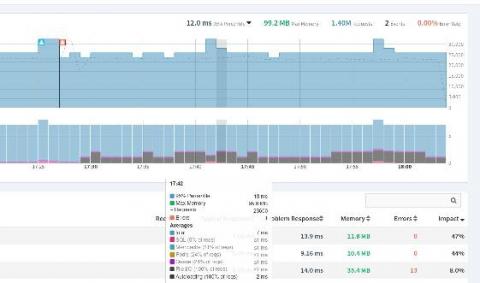
Ruby has always been known for the productivity it brings to its developers. Alongside features such as elegant syntax, rich meta-programming support, etc. that make you productive when writing code, it also has another secret weapon called TracePoint that can help you “debug” faster. In this post, I’ll use a simple example to show you 2 interesting facts I found out about debugging.

Logging in Go: Choosing a System and Using it

Go has built-in features to make it easier for programmers to implement logging. Third parties have also built additional tools to make logging easier. What's the difference between them? Which should you choose? In this article Ayooluwa Isaiah describes both of these and discusses when you'd prefer one over the other.

Go Fast: Getting Started with Sanic for Python

Tired of waiting for sluggish HTTP requests to complete before your backend code can proceed with other things? Sanic is an asynchronous web framework in Python, that is built to be fast. In a world where Flask and Django are the most preferred web development options in Python, Sanic is the new kid on the block. It’s a promising alternative that is not only faster but also delivers efficiency, simplicity, and scalability.

Introducing BigQuery column-level security: new fine-grained access controls

We’re announcing a key capability to help organizations govern their data in Google Cloud. Our new BigQuery column-level security controls are an important step toward placing policies on data that differentiate between classes. This allows for compliance with regulations that mandate such distinction, such as GDPR or CCPA.

SOLID Design Principles Explained: The Single Responsibility Principle

SOLID is one of the most popular sets of design principles in object-oriented software development. All of them are broadly used and worth knowing. But in this first post of my series about the SOLID principles, I will focus on the first one: the Single Responsibility Principle.

The journey to democratize data continues

Data is the new oil and a critical differentiator in generating retrospective, interactive, and predictive ML insights. There has been an exponential growth in the amount of data in the form of structured, semi-structured, and unstructured data collected within the enterprise. Harnessing this data today is difficult — typically data in the lakes is not consistent, interpretable, accurate, timely, standardized, or sufficient. Scully et. al.