Systems | Development | Analytics | API | Testing

Ship iOS and Android builds twice as fast on GitHub Actions

Last year, Nathan Hillyer's iOS platform engineering team at ForeFlight had self-hosted Mac hardware in their office, two engineers keeping them alive, and a codebase with over 2 million lines of Objective-C, Swift, and C++. Every Xcode update was a fire drill. Every capacity spike during a merge meant somebody was physically racking hardware in the Austin office. ForeFlight didn't want a new CI system. They wanted to stop being a data centre.


AI agent streaming in action: barge-in, human handover, and session continuity

You're mid-conversation with an AI support agent. You've explained the problem, the agent is halfway through a response, and the connection drops. When you reconnect, the response is gone. You type the same question again. The agent asks the same clarifying questions again. Three minutes of context, gone. Not because the model forgot it, but because the delivery layer stored nothing.

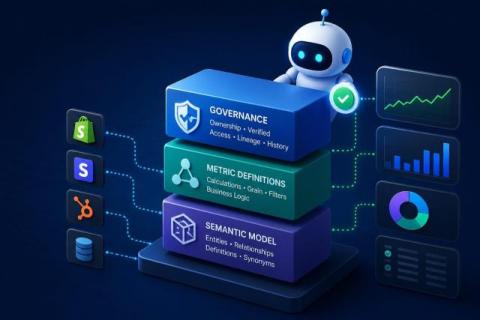
Why AI Agents Need a Semantic Layer (and What That Actually Means in 2026)

Everyone is racing to put an AI agent on top of their data. Almost nobody is asking whether the agent can be trusted to act on what it sees. That is the wrong order. And the way most teams are trying to fix it — bigger context windows, more reasoning, another eval — is also wrong. The generative model stopped being the hard part of agentic analytics months ago. Wiring an LLM to a warehouse is a weekend project.

Open Source Registries Are Changing: Here's How Bitrise Keeps Your Builds Running

There is a shift happening in a previously quiet corner of the open source community. You may have experienced this in your own Android builds with an HTTP 429 ("Too Many Requests") error during dependency resolution from Maven Central. Over a period of a few days in late April to early May 2026, a subset of Bitrise users experienced these errors. Here's what happened, what we did about it, and what it means for you.